Today – Friday, May 22nd —is the deadline for responses to the lawmakers’ letters
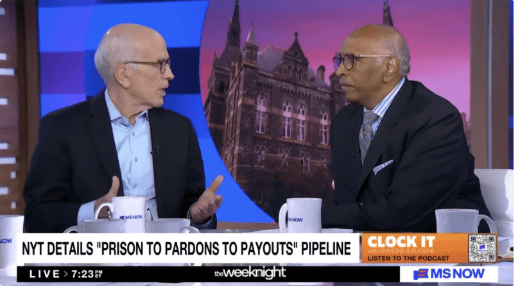
WASHINGTON, D.C. — Thursday evening, U.S. Senator Peter Welch (D-Vt.), Ranking Member of the Senate Judiciary Subcommittee on The Constitution, alongside U.S. Representative Dave Min (D-CA-47), Member of the House Committee on Oversight and Government Reform and Chair of the Congressional Progressive Caucus’ Anti-Corruption Task Force, joined MS NOW’s The Weeknight to discuss their new sweeping oversight effort into a series of pardons and commutations issued by President Trump that raise serious concerns about corruption, transparency, and abuse of executive power.
“Well, what you saw today, where the Republicans were unable to even get a vote… he wanted them to vote on the ballroom; he wanted them to validate the $1.8 billion slush fund. And of course, that’s on the heels of what Dave and I have been focusing on, and that is the pay-for-play pardon issuance, where you pay a lot of money, you make a big contribution, you get a pardon. And that is a staggering lineup of corruption for folks to get behind,” said Senator Welch. “I think the ballroom and the slush fund are very visible and very visceral for everyday people. So, you’re seeing a lot of Republicans push back, and they resisted even taking up a vote on continuing on the appropriations bill.”
“[President Trump] getting the $1.8 billion that he wants and selling pardons—it’s combined with a budget that we were about to vote on that did nothing about health care costs, did nothing about electricity costs, did nothing about food costs, did nothing about gasoline. It was literally just a finger in the eye of folks who are struggling to pay their bills…” Senator Welch continued. “At the end of the day, people really are repulsed at this. Americans are willing to work hard. They don’t mind hard work, but at the end of the month, they want to be half a step ahead, not two steps behind, because we’ve got a government that’s spending $1 billion on a ballroom and $1.8 billion on paying off criminals.”
“These January 6th insurrectionists, a lot of them had previous criminal records… These are not good people, and there are people right now who have gone and done the worst things after being pardoned by Donald Trump, who are now set to receive millions of payments—millions of dollars of payments—and that’s just wrong. And that’s one of the reasons that Senator Welch and I decided that we needed to go after this pardon power,” said Representative Min. “One thing we’re considering doing is talking about doing an op-ed around the pardon power, because it really hasn’t been researched enough.”
“But in the context of this settlement—this outrageous settlement—I just want to note something… A settlement is a type of contract, and you can’t have a contract when you don’t actually have two parties. And that was something the judge was pointing out. This is not a real contract. It is an Executive Order issued by the DOJ…” Representative Min continued. “Now, if Donald Trump wants to make the case that we should be giving $1.8 billion out to the Proud Boys and January 6th insurrectionists, he can make that case to Congress, but we are the ones who have the power of the person. He is right now violating the law, just as he’s done every single day in this administration, and there has to be consequences. We have to rein in that pardon power, among other things.”
Watch the Senator’s full joint interview with Rep. Min below:
The lawmakers sent letters to 17 individuals who received pardons or commutations under circumstances that warrant further congressional scrutiny, including several individuals connected to major fraud schemes, financial crimes, and high-profile political or financial relationships tied to President Trump and his associates. The letters seek information regarding the clemency process, including whether financial contributions, lobbyists, intermediaries, or personal connections played a role in securing presidential clemency.
Among the individuals receiving letters are convicted fraudsters, political fundraisers, corporate executives, and wealthy donors, such as Changpeng Zhao, whose cases have generated public reporting suggesting unusual access to Trump’s network of political allies and associates, direct lobbying efforts, large political donations, or other concerning connections surrounding their clemency requests.
A full list of letter recipients can be found here, and a full list of the letters can be found here. Responses to the lawmakers’ letters are due today, Friday, May 22nd.
###