
Welch: “We want people who owe taxes to the United States Treasury to pay taxes.”
WASHINGTON, D.C. — Today, U.S. Senator Peter Welch (D-Vt.), a member of the Senate Finance Committee, pressed Internal Revenue Service (IRS) CEO Frank Bisignano about how the Trump Administration has exacerbated the national deficit and changed policies to make the wealthiest Americans richer, all at the expense of working Vermonters.
At the hearing, Senator Welch emphasized how extreme staffing cuts at the IRS—under the administration’s so-called ‘Department of Government Efficiency’ (DOGE)—made it harder for working Americans to get help, created billions in lost enforcement revenue, and widened the tax gap, which represents the difference between taxes owed and taxes paid.
“Here is the reality, ok? The new Trump Administration came in and eviscerated the staffing at the IRS. It also changed its policy on audits of very wealthy individuals. It’s incredibly complicated—those audits—things that wealthy people can do to avoid stating what their income is and inflate their expenses. That has happened…That is a problem—that is the responsibility and burden you have to address and get that number down,” said Senator Welch.
Watch Senator Welch’s full remarks below:
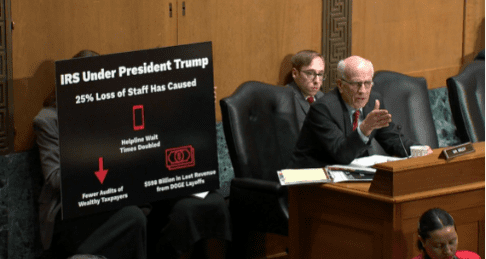
Read a key exchange between Senator Welch and IRS CEO Bisignano:
Sen. Welch: There have been significant cuts in the staff for enforcement. This chart here shows that 25% loss in staff has led to longer wait times—and I understand that you dispute that—but that is our experience in Vermont. And also, $598 billion in lost revenue from DOGE layoffs…One of your predecessors in the Trump Administration—Mr. Rettig, you know him. He says that while he described the agency as ‘outgunned by wealthy well-advised taxpayers,’ Mr. Rettig estimated that the tax gap—which is the difference between taxes owed and taxes paid—was approaching $1 trillion a year. That’s from a Trump appointee who shares your concern about collection. What is your number? What do you think is not collected from wealthy individuals?
Mr. Bisignano: My number is, the last reported tax gap was $650 [billion], and I think we’re undergoing a review of what’s the actual addressable tax gap and how to close that gap.
Sen. Welch: Well, let me ask: the review has to be done. I mean, there’s a well-known tax gap, and that is something that your predecessor in the Trump Administration acknowledged—$1 trillion a year. That has got to freak you out. I mean, what are you doing about it?
Mr. Bisignano: Well, like I said, the last reported one was $650 [billion]. He was projecting out. There’s no document that was produced at a trillion [dollars], but 650 is big enough, so we don’t have to debate the trillion.
Sen. Welch: But here is what’s happening: I mean, the number of staff assigned that are assigned has diminished. There were the DOGE cuts that did a lot of damage to the organizational structure and the morale. You didn’t do this, this is something you inherited, but it’s something you have to address. And then, Mr. Rettig says we’ve got a trillion dollars in the tax gap. That is just totally unacceptable to everyday Americans who are trying to pay their bills.
Mr. Bisignano: …What we’ve done is bring in a ton of technology, we have, uh—
Sen. Welch: Well, we need you to bring in a ton of money from people who owe it…We don’t want a ton of technology, we don’t want a plan, we want people who owe taxes to the United States Treasury to pay taxes to the United States Treasury.
###